
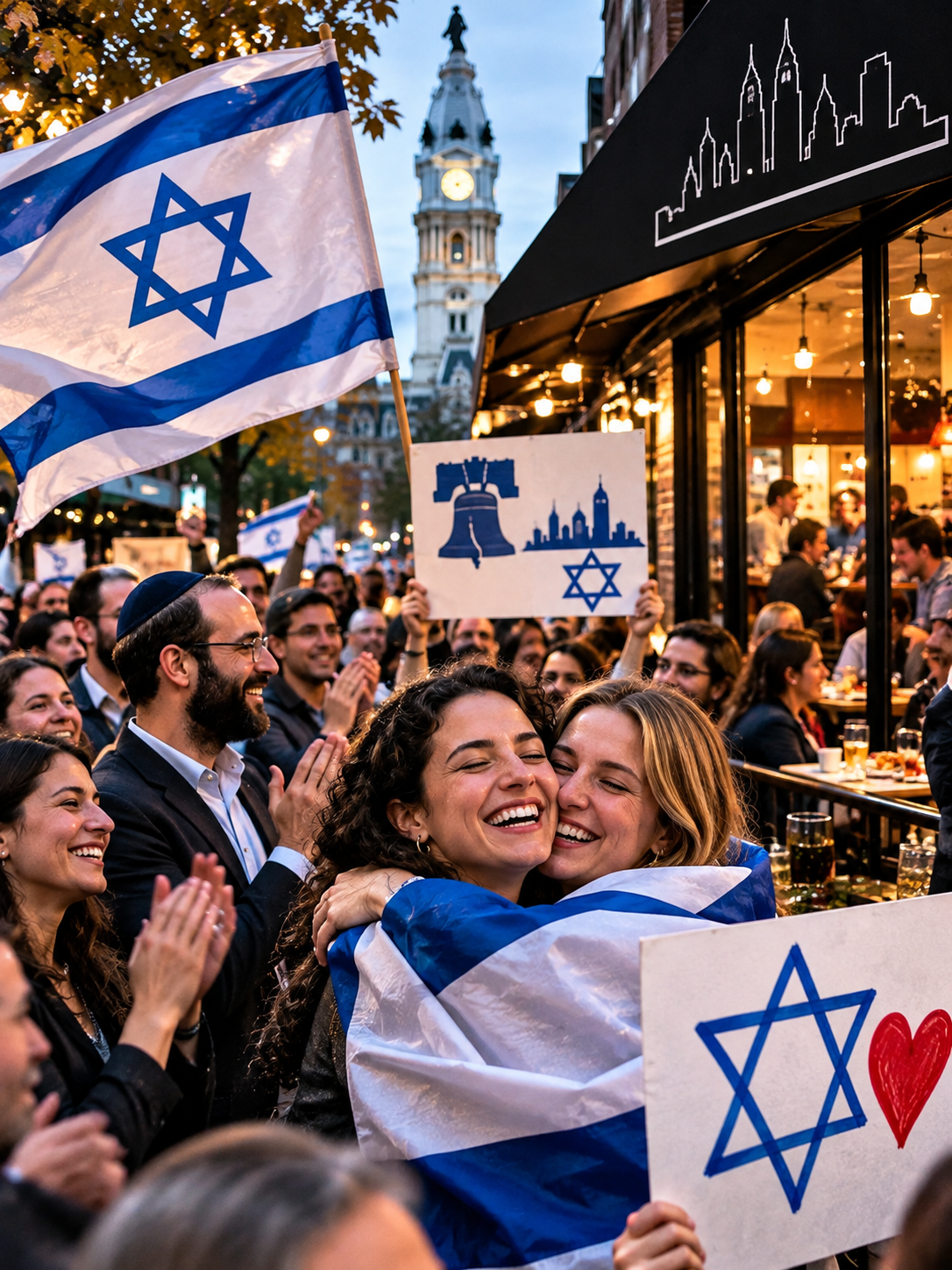
What was supposed to be a day of intimidation against Jewish-owned businesses in Philadelphia turned into an extraordinary demonstration of unity, solidarity, and resistance to hate.
On Sunday, November 8, a pro-Palestine aligned group calling itself Philly Bike On Your Left organized a coordinated bicycle boycott targeting six Jewish- and Israeli-owned restaurants in Philadelphia's Rittenhouse Square neighborhood.
The organizers accused the businesses of supporting Israel and circulated promotional materials declaring that Zionist establishments had to go.
But the date of the demonstration carried a particularly disturbing historical significance.
November 8 fell just one day before the 88th anniversary of Kristallnacht, the 1938 Nazi pogrom known as the Night of Broken Glass, when Jewish homes, synagogues, and businesses were attacked across Germany and Austria. Thousands of Jewish businesses were destroyed or damaged, and approximately 30,000 Jewish men were arrested and sent to concentration camps.
For many in Philadelphia's Jewish community, the parallels were impossible to ignore. Organizers of the boycott, however, maintained that the timing was unintentional and that their protest was directed at support for Israel, not Jewish identity.
Rather than respond with fear, Jewish charities, community organizations, interfaith allies, and Philadelphia residents came together to turn the boycott into a massive show of support.
The Jewish Federation of Greater Philadelphia helped mobilize the community. The nonprofit JewBelong installed 14 billboards across the city challenging the boycott, while the Anti-Defamation League encouraged residents to patronize Jewish-owned restaurants.
Hundreds of supporters flooded the neighborhood, waving Israeli flags, singing songs, and lining up outside the very establishments protesters had hoped to hurt.
The six targeted businesses included Mac Mart, K'Far Café, Huda, Goldie, Dizengoff, and Schlesinger's Deli.
And the community's response was remarkable.
According to Jewish Federation CEO Michael Balaban, all six restaurants sold out of their inventory. Some customers reportedly waited hours to make purchases, determined to show that Jewish business owners would not be intimidated.
"What was supposed to be a boycott of Jewish businesses turned into a food festival of Jewish businesses," Balaban said.
Even Pennsylvania Governor Josh Shapiro and Philadelphia Mayor Cherelle Parker condemned the targeting of Jewish-owned establishments, emphasizing that political disagreements should never become excuses for intimidation or discrimination.
The events were a reminder of why history matters.
Eighty-eight years ago, Jewish businesses were attacked while much of the world stood by. Today, in Philadelphia, people of different faiths and backgrounds stood shoulder to shoulder to defend their neighbors.
There is nothing wrong with criticizing Israel or protesting government policies. But targeting Jewish business owners for collective punishment crosses a dangerous line.
And on Sunday, Philadelphia showed that hatred does not have to get the final word.
The protesters came hoping to empty restaurants. Instead, they helped fill them.
They came hoping to isolate a community. Instead, they brought that community together.
They came to send a message of exclusion. Philadelphia answered with solidarity.
In a world where antisemitism too often dominates the headlines, this story offers something we desperately need: hope.
Hope that communities will continue standing up for one another. Hope that people will refuse to remain silent when their neighbors are targeted. And, above all, hope that there are far more people willing to fight against hate than there are people who choose to hate.
