
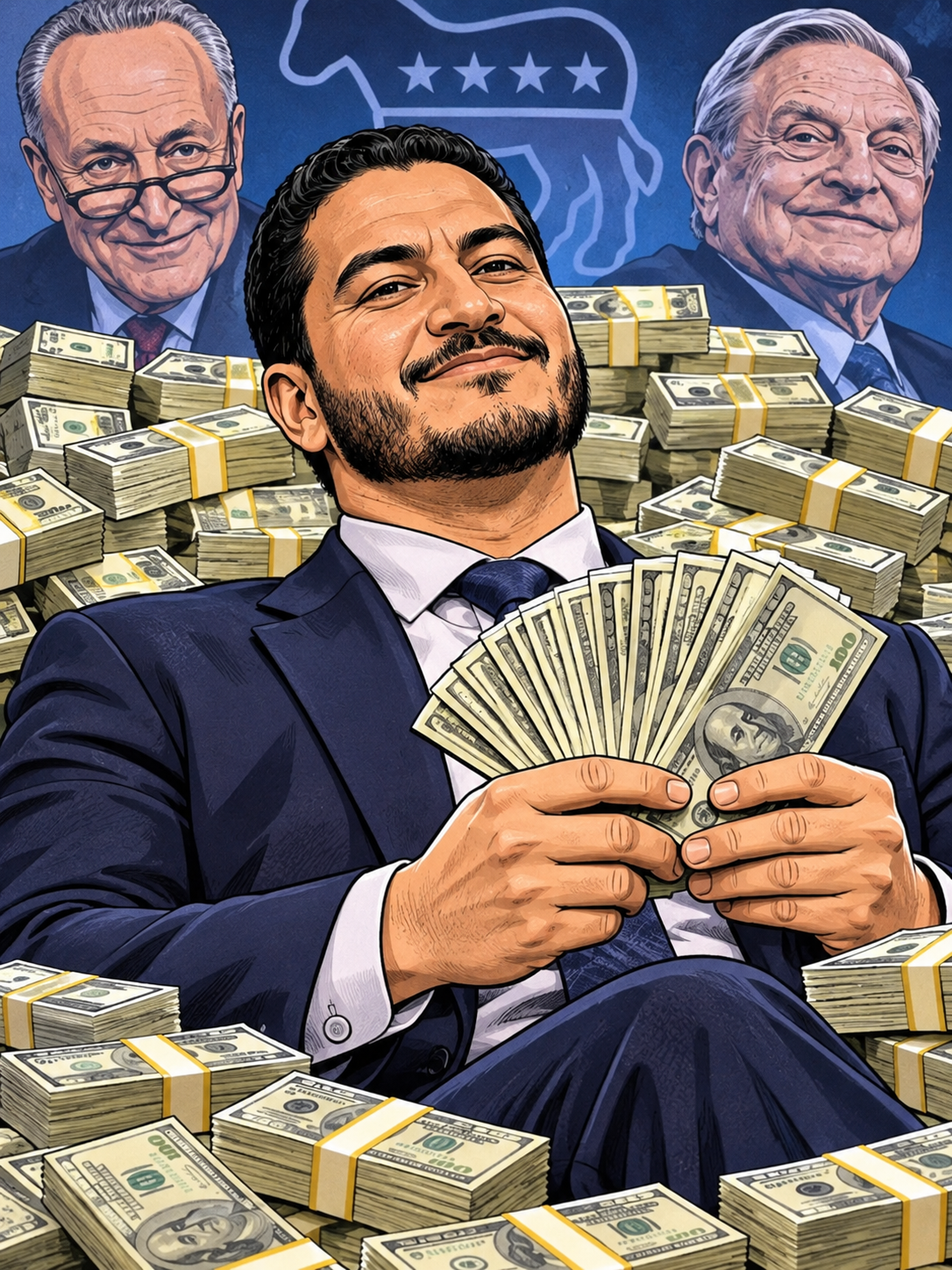
Less than a week after his election victory, El-Sayed established Habibi PAC, a leadership political action committee designed to raise money for other Democratic candidates and expand his influence within the party ahead of the 2028 election cycle.
The move is raising eyebrows because El-Sayed made opposition to wealthy political donors a central theme of his campaign.
"I want to get money out of politics, put money in your pocket, pass Medicare for all," El-Sayed declared during his campaign.
Yet his own path to Washington benefited from the very kind of massive political spending he has repeatedly criticized.
In September, Senate Majority PAC, the powerful Democratic super PAC aligned with Chuck Schumer, announced that its spending commitment in Michigan had reached $30 million to help elect El-Sayed and defeat Republican Mike Rogers.
The money wasn't handed directly to El-Sayed's campaign. It was outside political spending, but it nevertheless represented an enormous financial advantage from the Democratic establishment.
And then there are the Soros connections.
In September, El-Sayed attended a California fundraiser hosted by Jeffrey and Catharine Soros. Jeffrey is the nephew of billionaire Democratic donor George Soros.
El-Sayed also received a Paul & Daisy Soros Fellowship in 2012, established by George Soros' older brother and sister-in-law.
Meanwhile, the Soros-funded Democracy PAC contributed $9 million to Senate Majority PAC, the same organization that committed $30 million to spending in Michigan. There is no evidence that those specific Soros contributions were earmarked for El-Sayed, but the overlapping financial networks illustrate how deeply interconnected Democratic political fundraising has become.
Now, with Habibi PAC, El-Sayed is entering the business of raising and distributing political money himself.
According to the Michigan Advance, campaign finance watchdogs are already questioning the decision.
Neil Thanedar, executive director of the Michigan Campaign Finance Network, highlighted the contrast between El-Sayed's campaign rhetoric and his new fundraising organization.
Leadership PACs can help politicians build alliances, support favored candidates, and increase their influence within their parties. Watchdogs also warn that their spending rules can create opportunities for questionable expenditures.
Because Habibi PAC is so new, its donor list and spending records have not yet been publicly reported.
The contradiction is difficult to ignore.
El-Sayed ran as an opponent of big-money politics, benefited from tens of millions in establishment-backed election spending, cultivated relationships with wealthy donors, and is now establishing his own political fundraising network.
His defenders can reasonably argue that participating in the current campaign finance system doesn't prevent someone from advocating reforms to it.
But voters are equally entitled to ask whether politicians who promise to challenge that system are becoming increasingly comfortable operating within it.
For a politician who wanted big money out of politics, Abdul El-Sayed certainly hasn't had much trouble benefiting from it.
